Joint-Space Empowerment for Dexterous Coordination in Tendon-Driven Hands

International Conference on Machine Learning (ICML) 2026

Spotlight Paper

Also presented at the 4th Workshop on Dexterous Manipulation: Scalable Learning for Human-Level Skills
Robotics: Science and Systems (RSS) 2026

Abstract

Searching for effective policies is notoriously challenging in overactuated tendon-driven systems, where each joint is actuated by many muscles or motorized cables. Although this redundancy complicates naive policy search, it also implies that effective control can be captured by a low-dimensional action manifold. To identify such a manifold, we introduce Joint-Space Empowerment (JoSE), a novel information-theoretic objective that quantifies how much control an agent has over its mechanical degrees of freedom. We frame manifold discovery as an optimal precoding problem—where a state-dependent precoder maps low-dimensional latent actions to high-dimensional actions—and derive its closed-form solution under learned control-affine Gaussian dynamics. Across both a musculoskeletal hand model and a tendon-driven robotic hand, we show that policies trained on this manifold achieve significantly enhanced dexterity, sample efficiency, and improved generalization. More broadly, these results present optimal precoding as a general information-theoretic paradigm for coordinating high-dimensional actuators to control low-dimensional features.

Joint-Space Empowerment

In overactuated tendon-driven hands—those with more actuators (muscles or motors) than degrees of freedom—many actions produce the same joint motion. As a result, a low-dimensional action manifold capable of realizing all possible joint motions should exist. Our goal is to discover this manifold.

We parameterize a manifold as a state-dependent precoder that maps a low-dimensional latent action into a high-dimensional action and formalize manifold discovery as an optimal precoding problem.

In the optimal precoding framework, motor coordination is viewed as a communication problem involving a sender, a noisy communication channel, and a receiver. At each time step, the sender transmits a latent action, which is sent over the communication channel and received at the next time step as the next joint velocities. The communication channel is composed of a precoder, the state transition probabilities and a joint-space decoder that reads out joint velocities from the full state. Because the precoder has learnable parameters, θ, the communication channel is adaptable.

Definition (Joint-Space Empowerment)

To learn the precoder, we introduce Joint-Space Empowerment (JoSE)—a novel objective that quantifies how much control an agent has over its mechanical degrees of freedom. Formally, for any state, JoSE is the largest mutual information between the latent action and the next joint velocities over all latent action distributions (i..e, the capacity of the communication channel). We aim to learn the precoder that maximizes JoSE.

A low-dimensional action manifold necessarily prunes the action space. The JoSE objective performs this pruning by retaining actions that produce unique joint motions, thereby eliminating behavioral redundancy. Intuitively, if multiple actions produce the same joint motion on average, JoSE selects the action that does so most reliably (i.e. with the least variance due to dynamics noise).

Task-Agnostic Action Manifolds

JoSE is fully specified by the precoder, the system dynamics and the joint-space decoder, with no dependence on rewards or task information. JoSE-optimized manifolds are therefore task-agnostic.

Closed-Form Solution

Under a control-affine Gaussian model of tendon-driven dynamics, we derive a closed-form solution to the optimal manifold: a state-dependent linear subspace.
Compositional Manifold Policies

JoSE enables sample efficient policy search by confining action exploration to a low-dimensional manifold. We exploit this structure by constructing policies supported on the manifold.

Dexterous Manipulation

Our compositional manifold policies learn complex contact-rich manipulation skills, outperforming baselines that either perform policy search over the full high-dimensional action space or coordinate actuators using demonstration-based or task-specific objectives.

Musculoskeletal Hand

We coordinate the 39 muscle-tendon units of the MyoHand by learning a 15-dimensional state-dependent action manifold

BaodingBalls

DieReorient

KeyTurn

PenTwirl

Tendon-Driven Robotic Hand

We coordinate the 42 tendon actuators of the Adroit hand by learning a 15-dimensional state-dependent action manifold

BaodingBalls

DieReorient

KeyTurn

PenTwirl

NeurIPS Competition: 1st Place

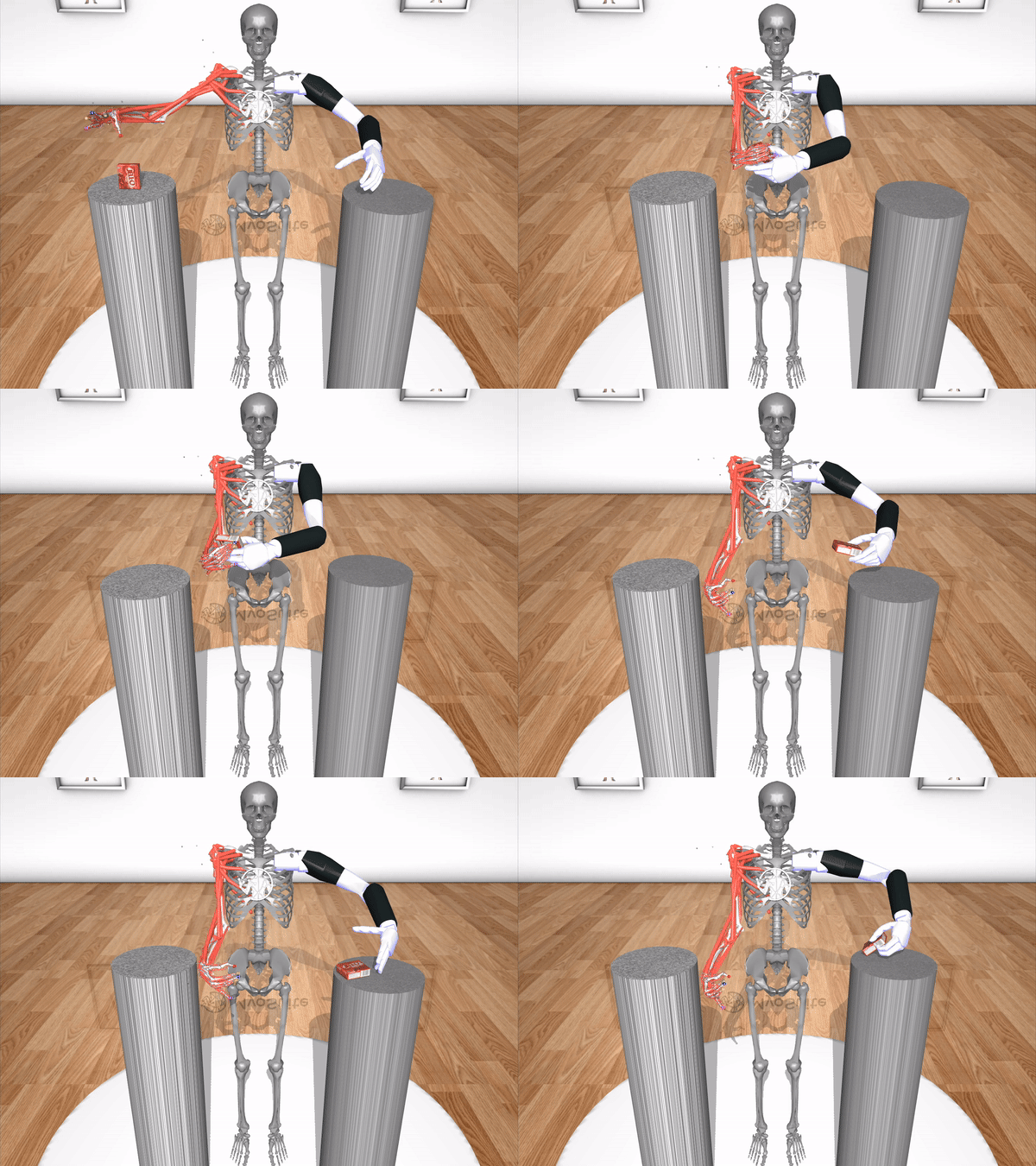
Our team, Muscle Heads, achieved first place in the Manipulation Track of NeurIPS 2024 MyoChallenge. The challenge involved controlling a realistic model of a human arm (27 DoF) and a prosthetic arm (17 DoF) to transfer objects between pillars. Using our empowerment-based objective, we coordinated the 63 muscle-tendon units of the human arm by learning a 9-dimensional state-dependent action manifold. This achievement demonstrates that the method scales to higher dimensional state-action spaces.

BibTeX

@inproceedings{heald2026jointspaceempowerment,
  author    = {Heald, James and Caggiano, Vittorio and Kumar, Vikash and Sahani, Maneesh},
  title     = {Joint-Space Empowerment for Dexterous Coordination in Tendon-Driven Hands},
  booktitle = {Proceedings of the 43rd International Conference on Machine Learning (ICML)},
  year      = {2026},
}